

How & why…
WingTips is a culmination of several different perspectives on Regional Air Mobility. Learn “why” there is a need for WingTips flights, “why” it is very difficult to deliver, and “how” we address the challenges.
The Why
Large pent up demand for a better travel option for the “in-between” trips that are just too long to drive, but the airlines don’t offer a solution.
Started in early 2000s with NASA Small Aircraft Transportation System Project to determine the viability of Point to Point flights on small aircraft
DayJet launched in mid-2000s to bring the service to Florida. Confimred existence of a market, but also hit several technical and operations challenges.
A Georgia Tech study forecasts that 248,000 passengers a day would use a WingTips flight if pricing is within $1-3/seat-mile. 90 million passengers a year is a multi-billion dollar market.
The How, part one
Data, advanded math, AI and tight integration with business operations
Big Data tells us patterns, a “Big Picture” view of travel patterns with granulairty. Big Data sends vital data to our AI Agents to drive a flight booking. Agentic AI holds a negotiation with a traveler during a flight request to find a trip that works. Linked to other IP for fleet/schedule optimization, WingTips can provide a response to a passenger request in real-time that meets the passenger’s needs, but also benefits WingTips operations.
Why is it difficult?
A matter of combinations
Airlines operate with preset routes and schedules, managing seat sales. WingTips provides Point to Point travel between local General Aviaiton airports. This service opens huge opportunies for communites, businesses, and travelers. But creates a problem that is hard to solve - getting people to group together onto routes, on the same day, at the same time. Wingtips IP addresses this problem and is the foundation of the companies value.
The number of possible combinations for WingTips flight requests is very large. The need to provide intelligent feedback to the passenger when booking a flight is key to making the service predicatable, useful and valuable.
The How, part two
Electrified aircraft shift the Cost Model
WingTips operates with current aircraft based on turbine engines burning Jet A fuels. This puts operating costs, and therefore the fares we charge, at the higher end of the Georgia Tech study. the $3/seat-mile.
Electricfied aircraft, specifically hybrid, dramatically shifts operating costs down. WingTips analysis forecasts passenger fares in the $1-2 per seat mile range. This makes WingTips economically comparable with driving yourself. But WingTips is 4-6 times faster than driving and often eliminates other travel costs, like overnights in a hotel.
“We had the most amazing experience with a new regional air service called WingTips. We may never fly commercial again.”
— Jenny Rose Hutzler, Travel Guru & Influencer
Jenny shares her WingTips experience.
Jenny is a retired princess navigating life as a wife and mom, she and her husband recently traveled from Santa Ana, CA to Santa Barbara, CA on WingTips. She’s now a big WingTips fan. We’ve summarized Jenny’s experience for you below.
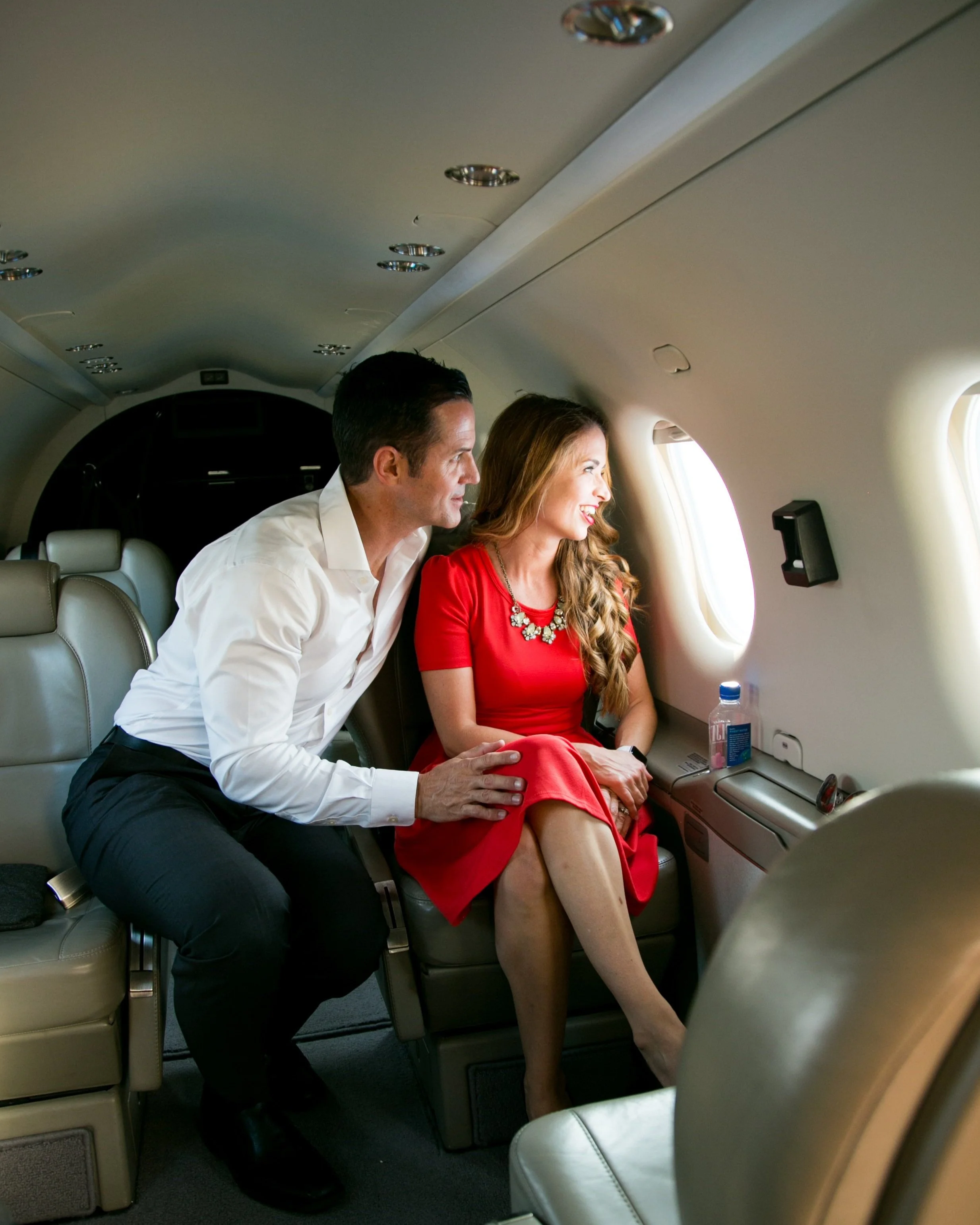
-
When you are wanting to book travel, WingTips works to match your flight request with other travelers that have the same destination. Matching your request with others, also known as crowd-scheduling, is what makes it more affordable than chartering your own flight.
-
You will need to visit the WingTips website and create an account and log in, then click ‘the private charter tab’ on the home screen. Enter your desired trip credentials and click the ‘request flight’ button. If there is an exact match, the flight will be displayed with a green icon. If not, you can join a flight request (which will appear as a light blue icon) or create a new flight request (dark blue icon). This is where WingTips uses "fuzzy computer code" to find other flights that may fit your trip request.
When you are searching for the best flight option, to match your request, you will be shown options for ‘Confirmed’ or ‘Request’ flights from the home screen. A ‘confirmed’ flight means a plane is already assigned and you can book a seat on that flight.
A ‘request’ is a flight that does not have a plane assigned. You can request a specific number of seats and WingTips will work to assign a plane to that flight once the passenger minimum is met. You will not be charged for the flight until a plane is assigned. At that point, a WingTips concierge representative will reach out to you with a link to book your seat.
Also, if you do not find a ‘flight’ or ‘request’ that matches your itinerary, there is a new option available! Customers can create their own flight request and only pay for it once an aircraft is assigned! This gives you the option to literally create your own travel schedule!
-
Think of the experience as flying first class, except without the airport hassle. Depending on the length of the trip, prices do vary. You can see flight prices by just placing your destination and origin on the home screen, and you will see a price quote. Note: prices generally land between $2-$3 per mile.
-
You are allowed one checked bag of 50 pounds to be stored, plus a personal bag for the plane. If you are traveling with kids and have a stroller and/or car seat that is not an additional charge, but just let them know you will have these items in advance. Obviously, if you have anything oversized like golf clubs or ski's there may be an additional fee.
-
Right now, Wing Tips is flying all to and from California, Nevada, and Arizona, but has plans to expand to Texan and the Southern Plains region by the end of this year. In the next three years, WingTips anticipates expanding across the US. This is HUGE NEWS!!! Make sure to sign up for their newsletter to receive updates on when service will be available in your area!
-
There are SO MANY REASONS I am now obsessed with choosing charter over commercial, but here are a few...
No more difficult airport parking. You pull up and they valet park your car for you and have it ready for you once you arrive back at your destination. Can you say, TIME SAVER?!?
No more long check-in lines! Once you show your photo ID and flight number you are good to go!
Clean waiting lounge with amenities like water, coffee, and snacks provided.
No more long security lines and getting half undressed while everyone is watching you while tossing out liquids you forgot were over 6oz. The friendly staff is there to help you take your bags from your car right onto the plane! Plus, everyone goes through a pre-screening when purchasing a ticket, so you can still feel safe!
No more waiting in the airport for hours before your flight. As soon as everyone has checked in the pilots are ready to go whenever you are!!
No more boarding hassle wondering if there will be space for your bags in the overhead compartment! Your larger luggage will be stored in the cargo area, all small purses and laptops can be taken on board with you.
No more germs of hundreds of other people on large flights!
Water, drinks AND snacks are actually provided on-board, unlike major airlines now that only offer water.
100% more convenient and faster than flying on major airlines!
-
Ok, I will be completely honest and say before I got to the airport I felt a little nervous. I had never flown on a smaller plane before, and of course being a mom, I was concerned. But after meeting our pilots in the lobby and chatting for a bit about the plane and their experience, I was immediately put at ease. Also, as soon as we had a super smooth take off and landing I was convinced this should be the only way we travel!
-
Depending on the length of the trip and how many passengers there will be, they have a few different planes. You can not choose the plane, it is based on the information below.
1-4 passengers traveling less than 150 miles = Cirrus Vision Jet
4-8 passengers traveling less than 150 miles = Cessna Caravan or Pilatus PC12
1-4 passengers traveling over 150 miles = KingAir
-
I think it's pretty safe to say that the empty roads of the pandemic have ended and California traffic is back in full force! A simple 1-2 hour drive can now take 3-5 hours depending on the day and time. If you want to do a special trip to Disneyland, but don't feel like sitting in all the traffic, this is your answer! If you want to do a unique anniversary weekend getaway to Santa Barbra, this is the answer so you aren't sitting on Pacific Coast Highway for HOURS! Want to go to Las Vegas or Palm Springs for a fun Bachelorette weekend, but don't want to sit in the car wasting time?!? Then WingTips is your answer!!